An Abridged Timeline: The Infamous Life of T. Charles Kobella and his Notorious Polski Hotel: , Part 1

Blasphemy & Bicycles

Note that this work is incomplete.The timelines we write are meant to be fluid and changing. That is one of the reasons they are described as abridged. Not only do we not include all the details in them, but there is always more to find, and always more to write. Overtime more sources are found, more stories are heard, and more tips are followed until a full article is ready to be written.

Stevens Point lost an interesting landmark this past month, a building that is said to have quite the sordid past. The Belke Manufacturing Company building was razed recently, and rumors have been floating around about its history beyond the lumber company for many years. But none that told much of the story behind the building, or maybe we should say the story ‘inside’ the building.
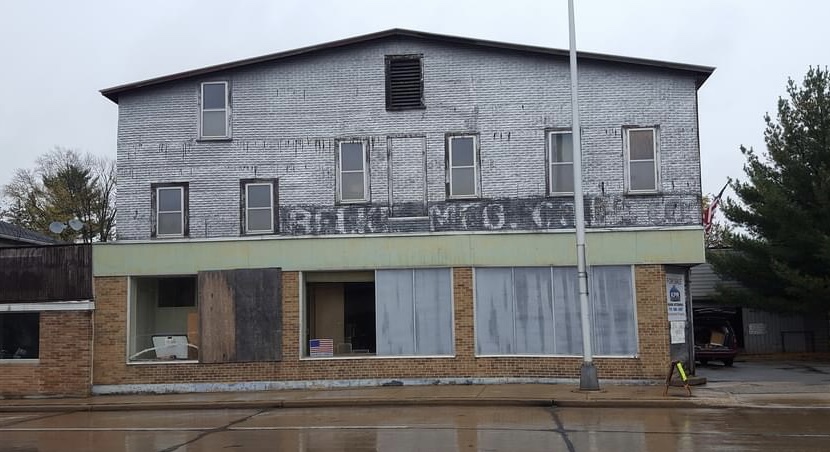
The Belke Manufacturer Company building circa 2018, Courtesy of Tammy and Chris Larson

Just as our work on Amelia Berg began with Wendell Nelson, so does on our research on the history of Kobella’s Polish Hotel. We are grateful to him, as always, for his work before us and hope we are able to expound on his considerable research overtime. We only wish we had the opportunity to speak with him about this notorious Stevens Point building, and so many others, before he passed. Alas, we pick up, hopefully near where he left off.

Please enjoy the beginning of our research on the infamous T. Charles Kobella and the history of his notorious disorderly house, The Polski Hotel.

Theophilus Charles Kobella was born in Poland around 1864 and arrived in the states with his family in 1882. He likely came to the Portage County with his parents, John and Rosalie Kobella shortly after arrival. According to genealogy records, by 1887 he had found a wife. Charles married Augusta (Augustina) Hintz/Hinca, on a cold day in January at a small Catholic church in Polonia, when he was 23 and she just 17. Together they had at least six children, three who survived to adulthood, Martha, born 6 months after the wedding, John, and Frank. Rose and Peter didn’t survive infancy. At some point after marrying, the Kobella family moved to 203 Portage Street (today 701 Portage Street) and began their, at first seemingly normal, but later, quite infamous and often difficult twenty years in Stevens Point.
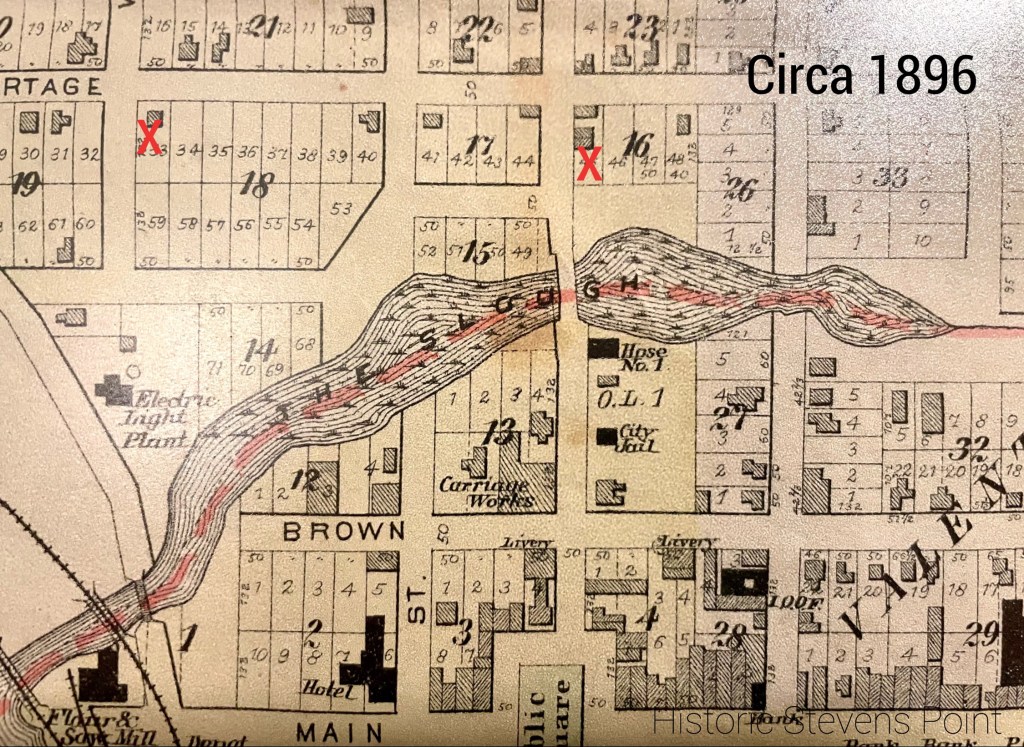
The area circa 1896. Historic Stevens Point Collection

June 1894 first known Stevens Point Daily Journal entry, Chas Kobella, 28, reported as fireman. He was hurt and bruised after being dragged by a team of horses while on the job. Kobella attempted to claim damages of $78.30, ($2,490.73 today) but it was rejected and disallowed by the Finance and Claims Committee.

1895-96 City Directory, ‘Kobila’ Charles, fire dept No 1, 203 Portage. He does not appear in previous editions
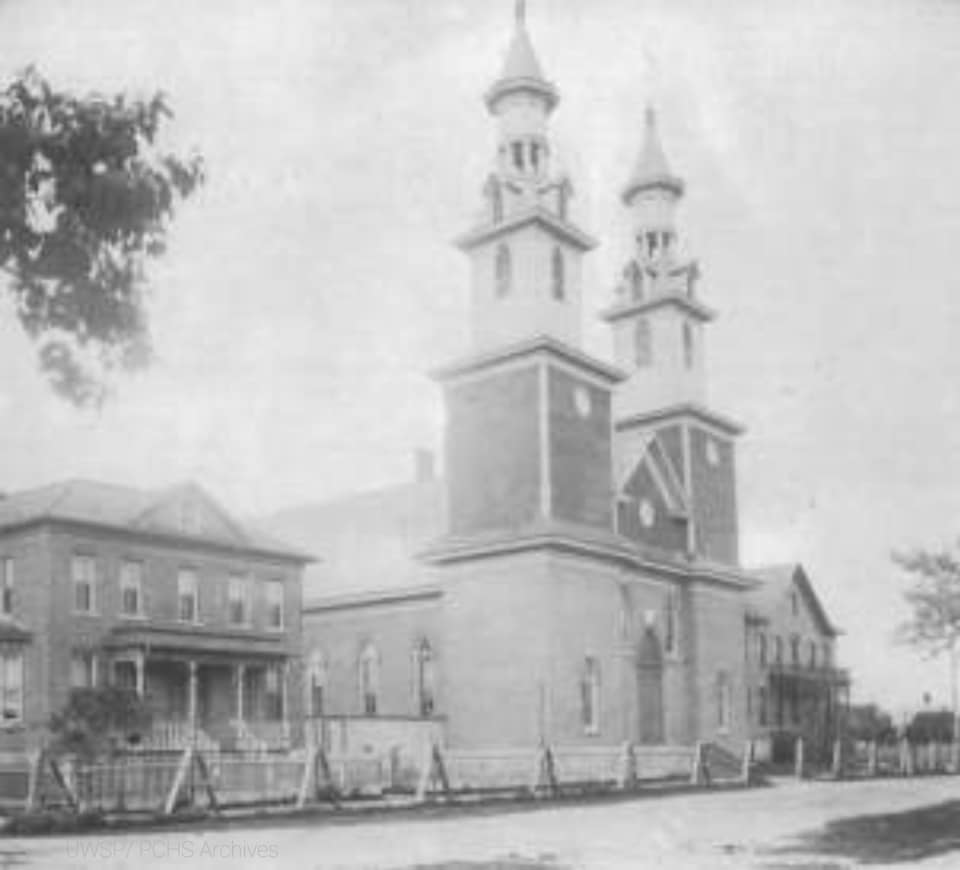
St Peters Church, before the fire. 1876-1896, PCHS Archives

October 1896, And so it begins… Kobella remained a member of the fire dept likely until he was arrested for stealing $20 ($636.20 today) in beer and wine from St Peter’s Church during a horrible fire on October 18, 1896. The original church building and adjacent properties were a total loss and a crushing blow to the Polish community. Kobella and the other gentleman involved pleaded not guilty and posted $100 bail each, the witness eventually dropped the suit, but the damage to his reputation was already done.

Feb 1897 Kobella builds a “gun and bicycle repair shop on North Second Street” with plans to open May 1. Bicycles were extremely poplar at the end of the decade due to the invention of the Safety bike with chain. Over 150 bicycle manufactures existed across the nation at the time so a bicycle repair shop would not have been a bad business venture. “He is now engaged in erecting a two story frame building 18×26 feet, just north of the slough. The upper story is to be finished off for living rooms.”
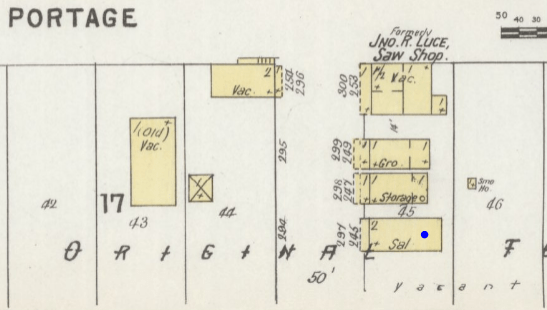
1898 Sanbon Fire Insurance Map

June 1897 Ad for bicycle repair appears in SPDJ, Hans Nielson, in the basement of 245 N Second Street
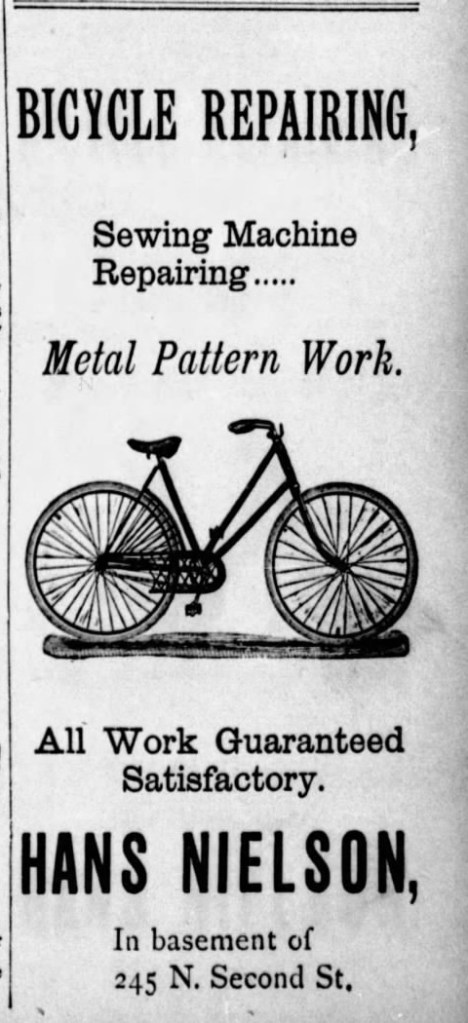
June 1897, SPDJ

Nov 1897 Kobella family is living in a one story house at the corner of Portage and West Street, there was a small fire that began in the cellar of the property which was reported in the papers
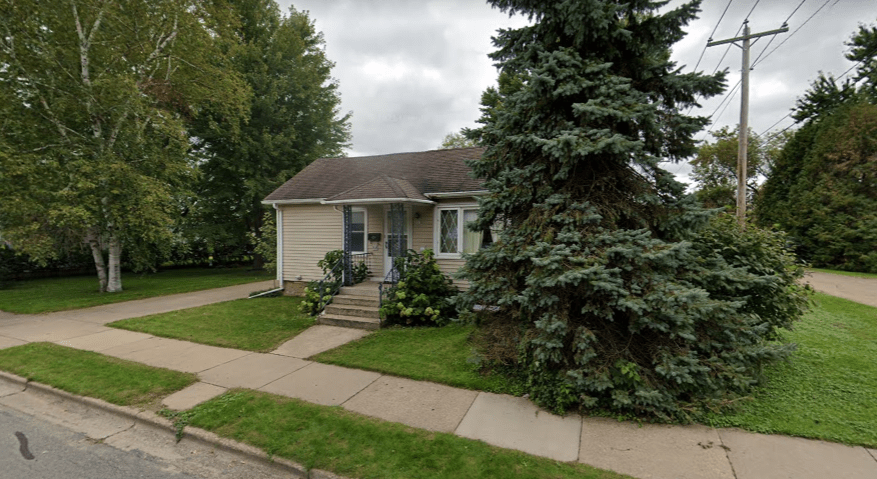
701 Portage Street today. West Street can be seen to the right, which has been a dirt alley like road for decades. Clipped from Google Images 2021, circa 2019

Dec 1897, uh oh, Little Martha ‘Kobiela’ is first on the list for tardy first graders in the Fourth Ward, but manages to be “promoted to Second Grade, in June of 1898.

1900 City Directory, ‘Kobela’ T. Charles, bicycle repair, res 245 N 2nd

1900 Census lists, Charles, 34, Gusta 30, Martha 12, John, 9, Frank 5, Peter 1, and servant Katie Worzela 17, notes that Gusta has birthed 6 children and only 4 are living. Peter died young and does not appear in 1905 records, nor the 1910 census.

April 1900 Ad in SPDJ for ‘Kobela & Raizner’ Bicycles, Hardware, Musical Instruments, 121 S Second Street, where The Cabin bar is located today.
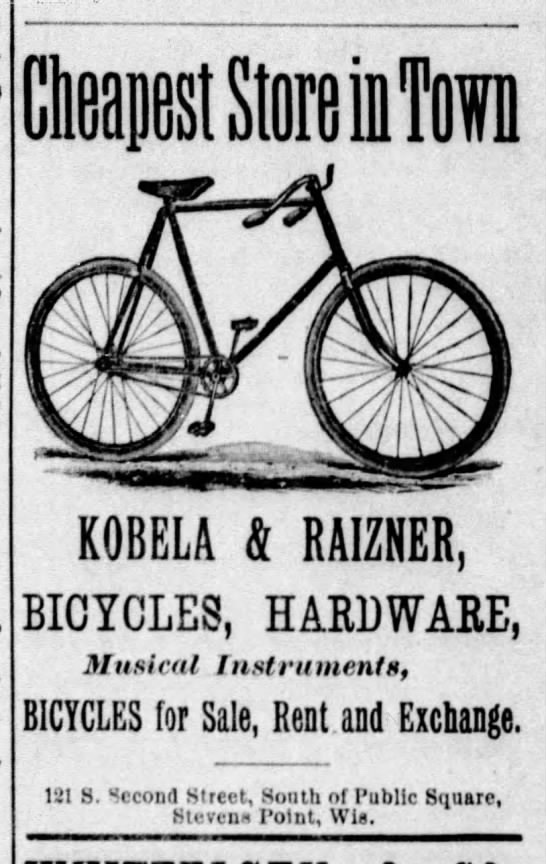
April 1900, SPDJ

May 1900, Kobella wheel stolen by woman who said she was going to Plover, but went to Mosinee and did not return it!

Aug 1900 Kobella charged with assault, first known recorded incident. A drunk man had caused some issues in Kobella & Raizner’s bike shop on S Second Street. The man swore in front of Kobella’s wife and young daughter, as well as a female patron. Kobella asked him to leave several times eventually throwing him out by the shoulders. The man claimed he was kicked in the stomach, but no one could corroborate the story. Kobella pleaded not guilty, and the case was dismissed.

Sept 1900 Jas. Pusdrowski paid a $50 fine for a Sept 15th assault on Charles Kobella

Sept 23, 1900, Kobella placed ad in SPDJ that he “has removed [his business] from Bishop’s block to 233 N Second Street, first building north of the Slough bridge.” This is the only time this address is used.
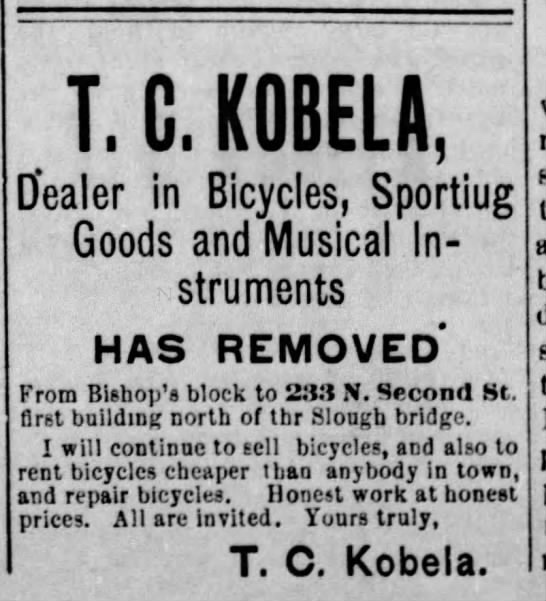
Sept 23, 1900, SPDJ

Oct 1901, Another wheel stolen from Kobella, 245 N Second Street. He placed ad with a description of the bike hoping for its return.

Mar 1902, Kobella opens a bicycle livery and repair shop on Clark Street at the rear of Strong’s barber shop with Cychoz, likely John Cychoz, Clark Street near Third
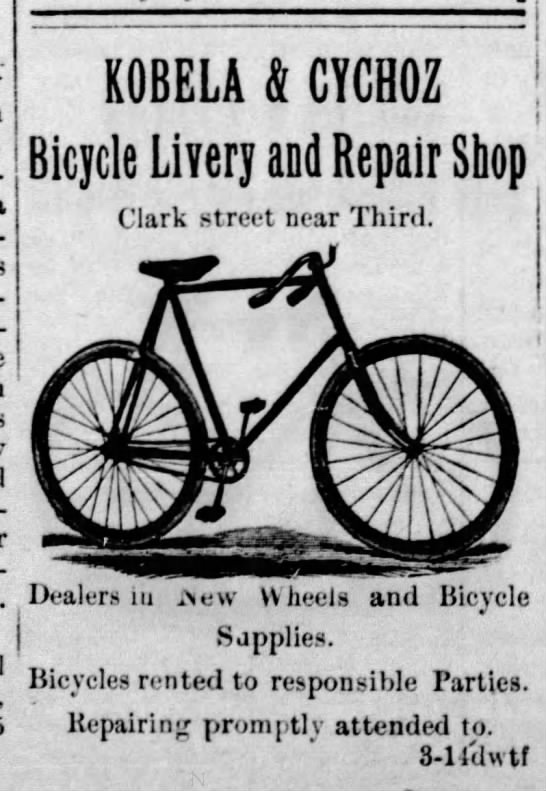
March 1902, SPDJ

Nov 1902 Kobella begins an addition to his building on N Second Street

1903-04 City Directory, Kobela T. Charles (T. C Kobela & Co) bicycle repairs, 247 N 2nd, Leon Kobela listed as barkeep at same residence.  

Aug 1903, Kobella announces that he will “embark in the hotel business and will cater especially to the Polish trade.” He had the “old Ciecholinski blacksmith shop moved from Portage Street” to the back of his building near the incline of the Slough to become a hotel stable.

Kobella’s new hotel at 245-247 N Second Street was soon to become a popular address, some would say, for all the wrong reasons…
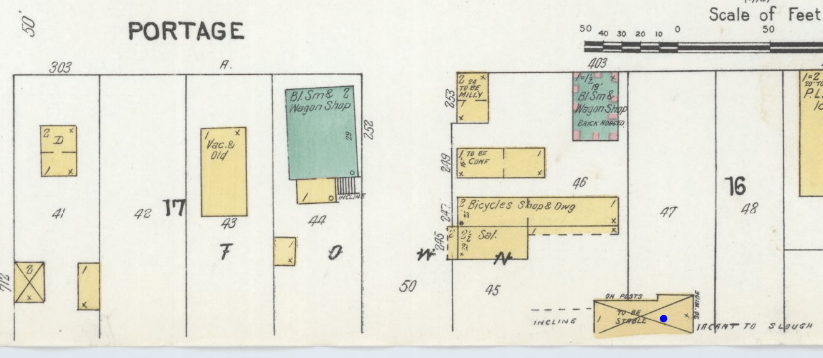
Sanborn Fire Insurance Map 1904,

Note: Kobella is spelled a variety of ways, we chose to use this spelling for uniformity as it is most commonly used in records and in both Augusta’s and Charles’ obituaries.

Watch for Part 2 coming soon!
Stevens Point’s Lost Carnegie Library: The Final Chapter

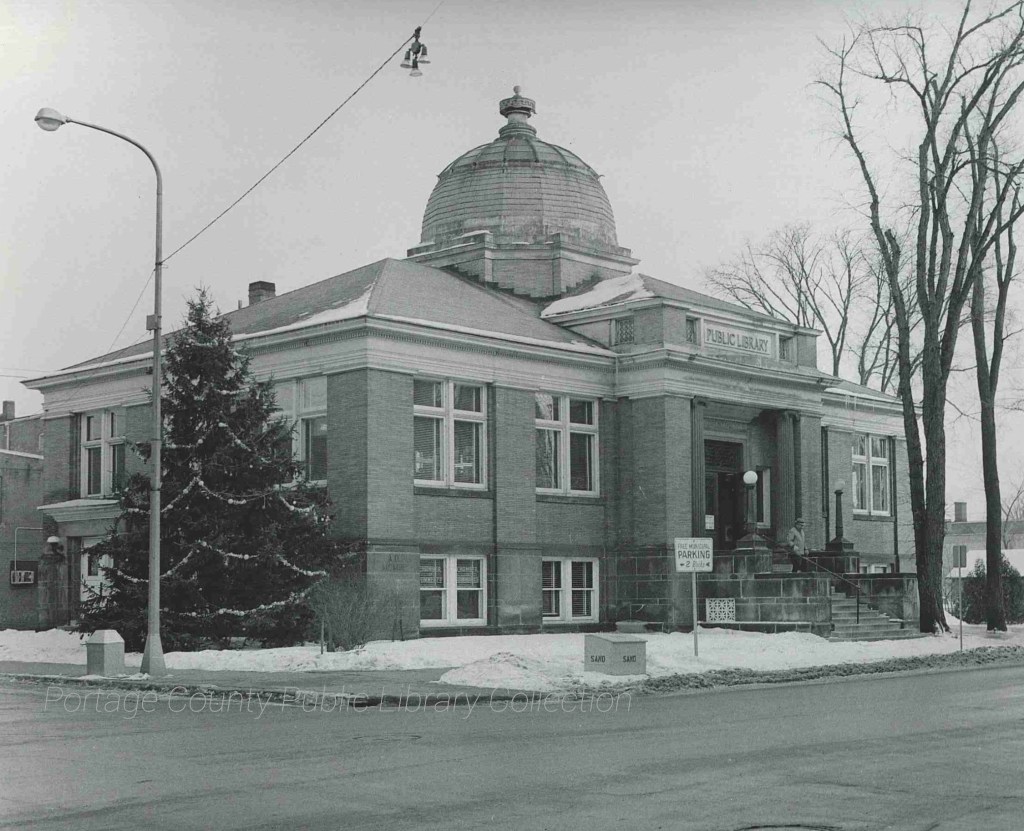
Courtesy of the Portage County Library, circa 1950/60s

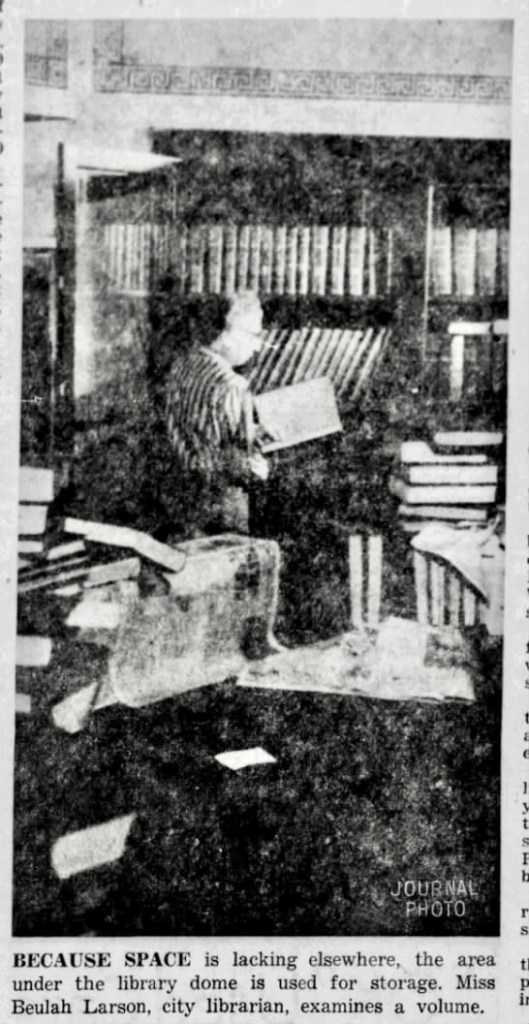
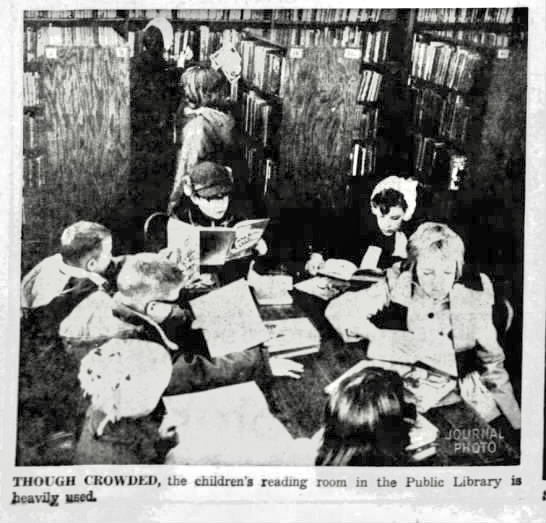
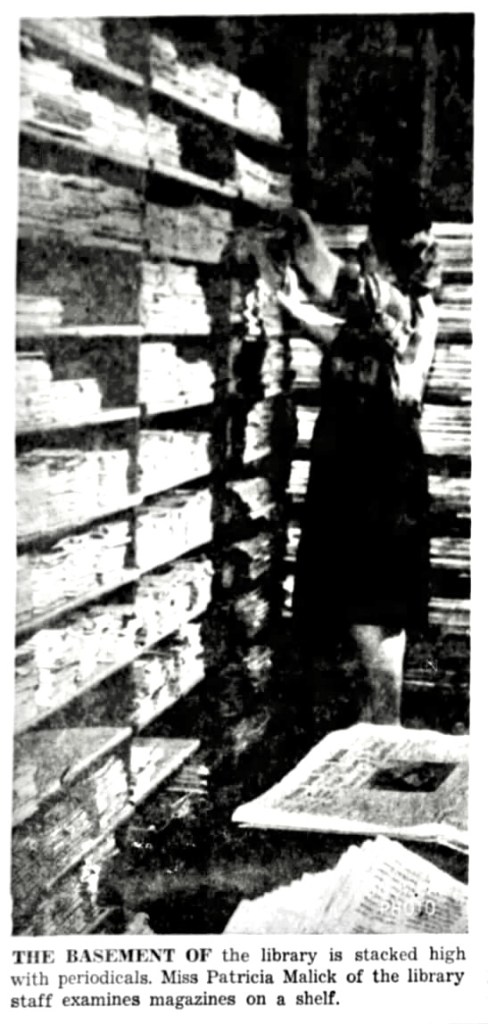
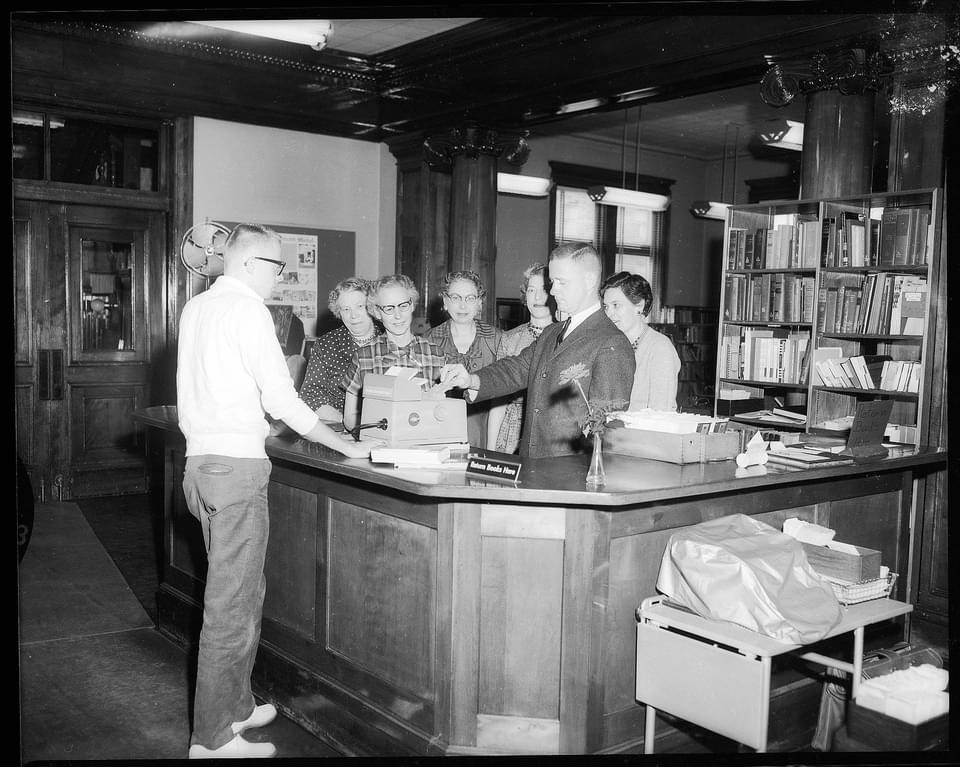
By the early 1960s complaints about overcrowding at the library dominated public discussion. The rotunda once a lovely sight, now called a “bothersome frill” was filled with stacks of bound magazines only reachable through a padlocked gate and the winding old staircase. “Originally, there was an opening in the first-floor ceiling and from the main desk you could look up into the dome. Later the opening was sealed,” and the beautiful special ordered green art glass was covered. Everywhere “book stacks standing where book stacks aren’t supposed to be.” Library officials declared that “the brick structure has outlived its usefulness as a library.”

Photos from the Stevens Point Daily Journal, January 24, 1964 showing how crowded the library had become. Stark difference than the 1914 photos posted in Part 4

Complaints of odd angles and no space for growth tabled talk about expanding the original structure. There was a preference to sell the old building and build a new modern library, but funding remained an issue. Then at the end of 1963, Charles M. White died and left $140,000 to the city. His intention was that it be used for a “project or building that will be beneficial” to the people of Stevens Point. Almost immediately it was decided that money would go towards the building of a new modern public library leaving the fate of the Carnegie Library in the hands of whoever purchased the building and land.

In April of 1966 construction began on the new Charles M White library at the corner of Church and Clark Streets, a historic corner where the city’s first church was built in 1853. It was also, ironically, next to where the high school burned in 1892 when the library lost half of its original collection. The new library would be built in the Brutalism style, a steep contrast to the Neo-Classical Revival styling of its Carnegie Library sibling just down the road.

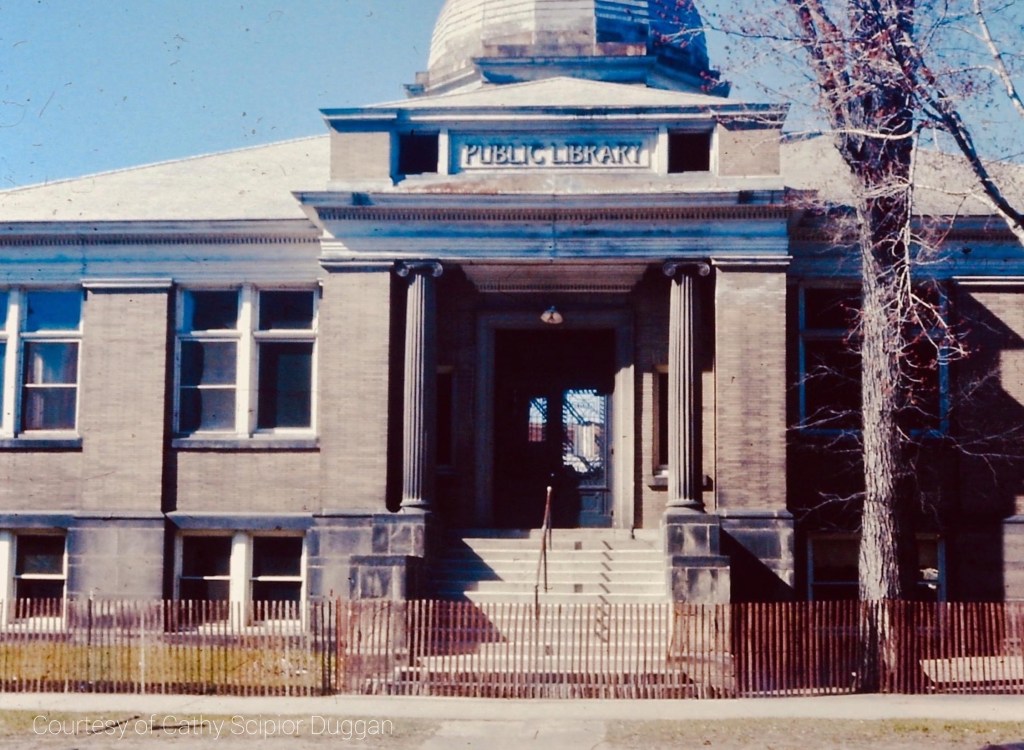
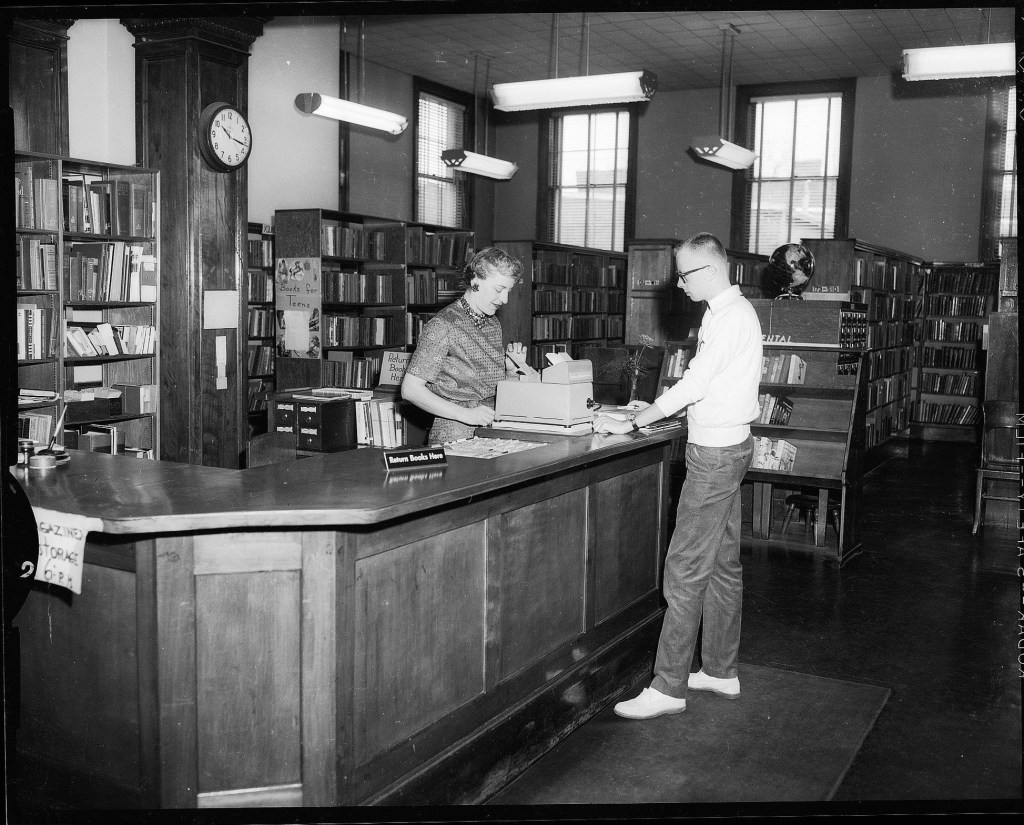
At the end of December 1967, Stevens Points Free Public Carnegie Library closed its heavy ornate doors and prepared for the move. Once again, the immense collection of books moved to a new home just down the block and once again, they found a new home on new shelving leaving the dusty old worn varnished shelves behind to meet their fate.

The Beginning of the End, Circa 1968, Photo courtesy of Cathy Scipior Duggan

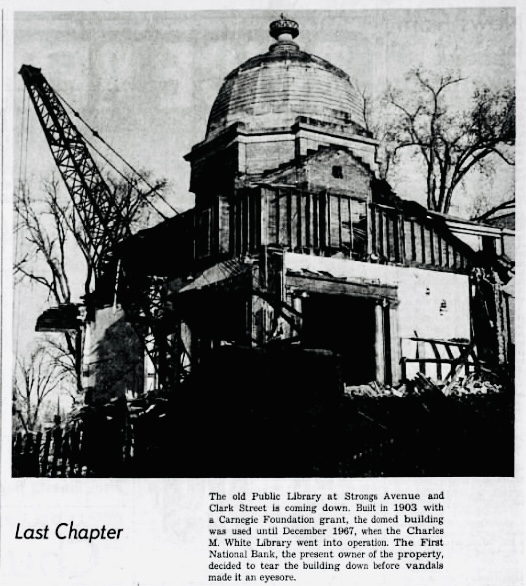
The building was sold to the First National Bank and sat empty for a few years. Then in April of 1969, the bank decided to demolish the building citing worries about vandalism. With that quick decision, one of the most important beautiful buildings to ever grace Stevens Point met its end nearly 65 years to the day of when Dr. Southwick received official word from Andrew Carnegie’s secretary. Nothing would be built on the land again, and today the site is covered in concrete and blacktop.

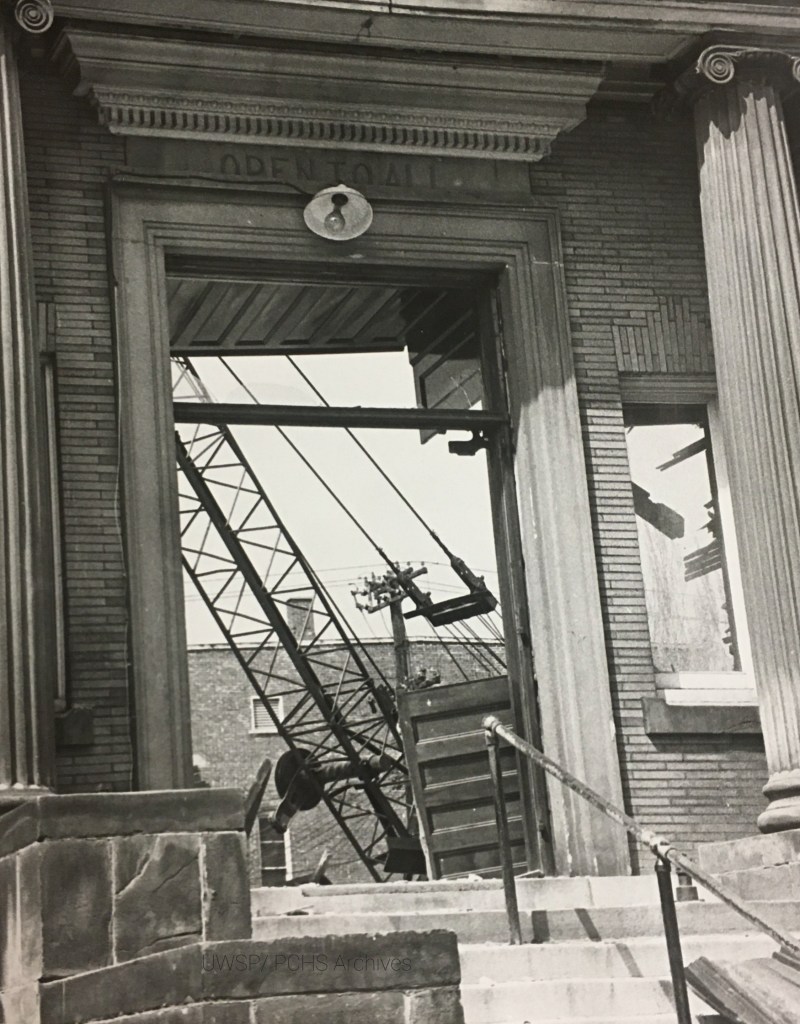
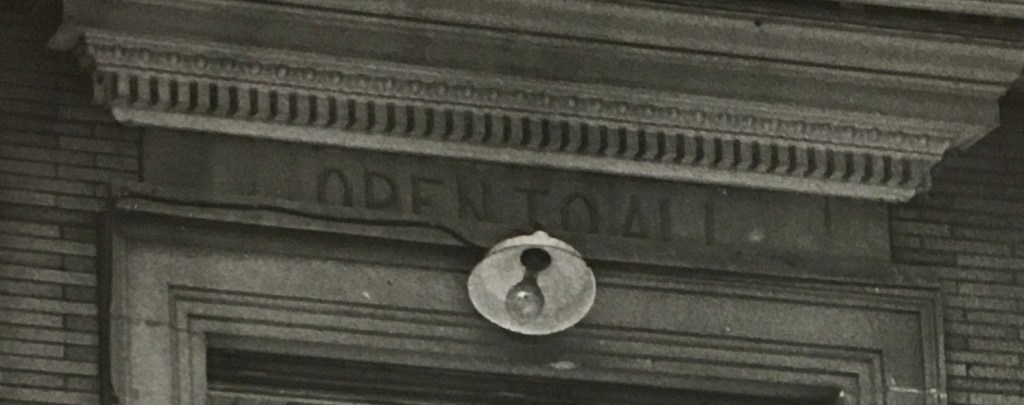
Open to All, yet forever lost to time
Mike Dominowki photo, UWSP / PCHS Archives

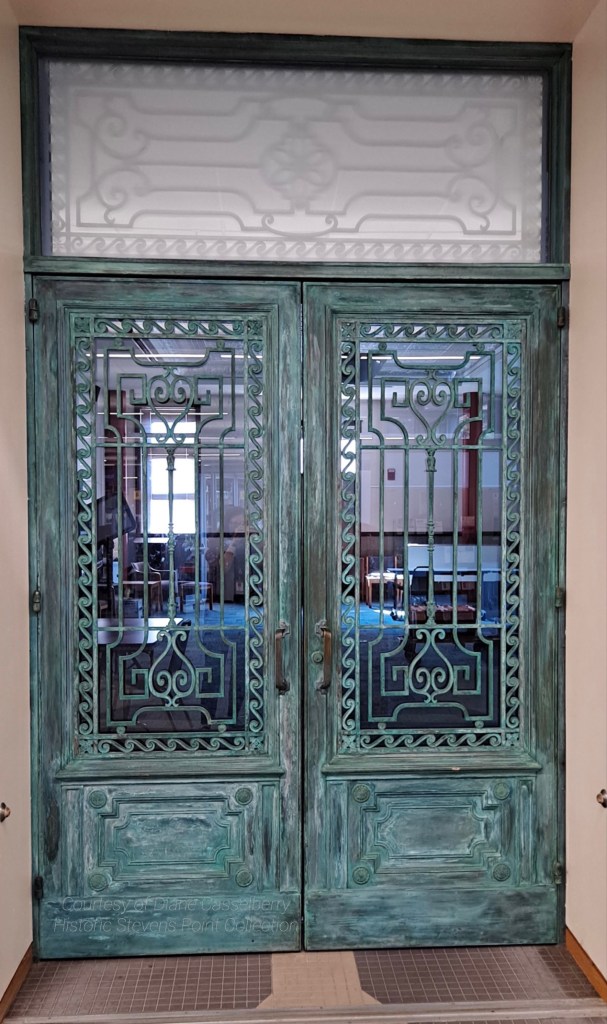
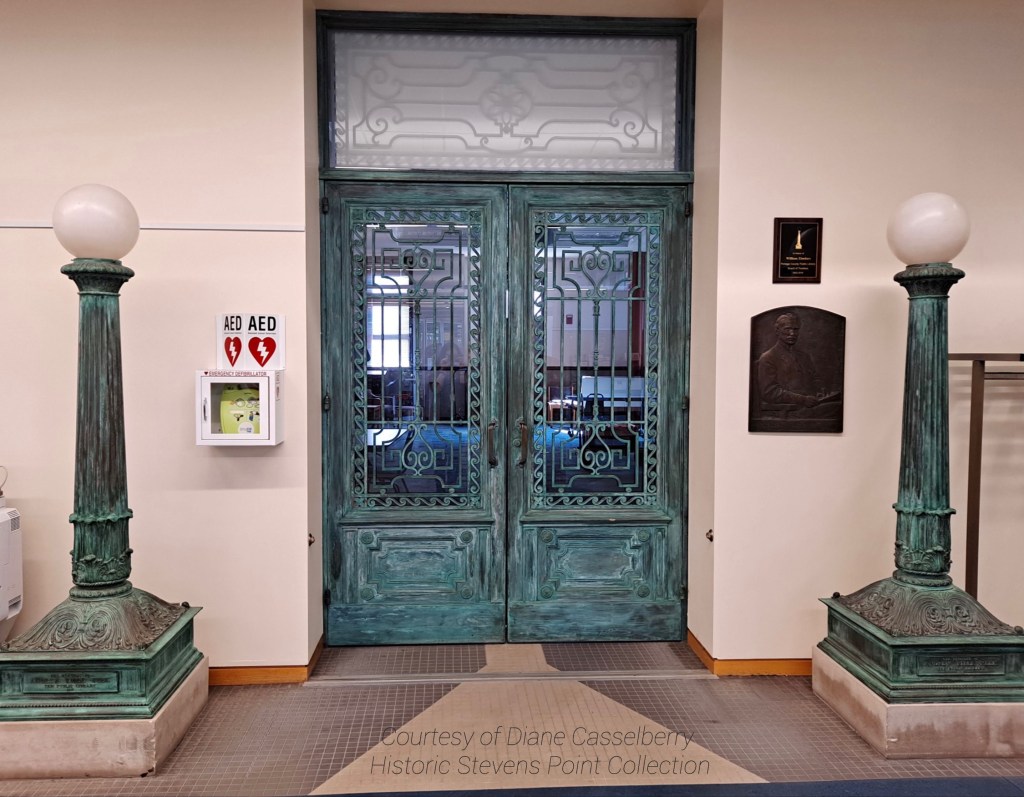
Mostly memories and photos remain, but you can still imagine a bit what it would have been like to walk through the enormous beautiful ornate brass doors of the original entrance. The doors and lamp posts were thoughtfully salvaged by those who realized their importance. Saved by local historian John Anderson and stored in the basement of the Old Main Building at the University, the doors safely sat and collected dust for a few decades. The lamp posts continued to be used and were moved to the front of the new Charles M White Library. Later, the lamp post silhouette was incorporated into the library logo. When the third and present library was built in 1992, the brass doors were dusted off and finally brought out of storage and given a new home. The lamp posts were reunited with the doors over a decade later completing a “new” library entrance and once again, “Open to All.”

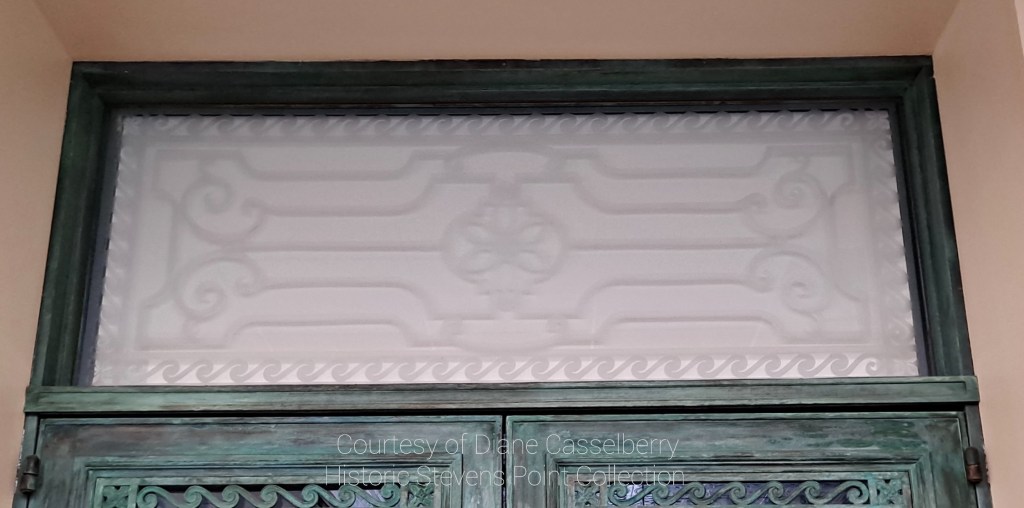
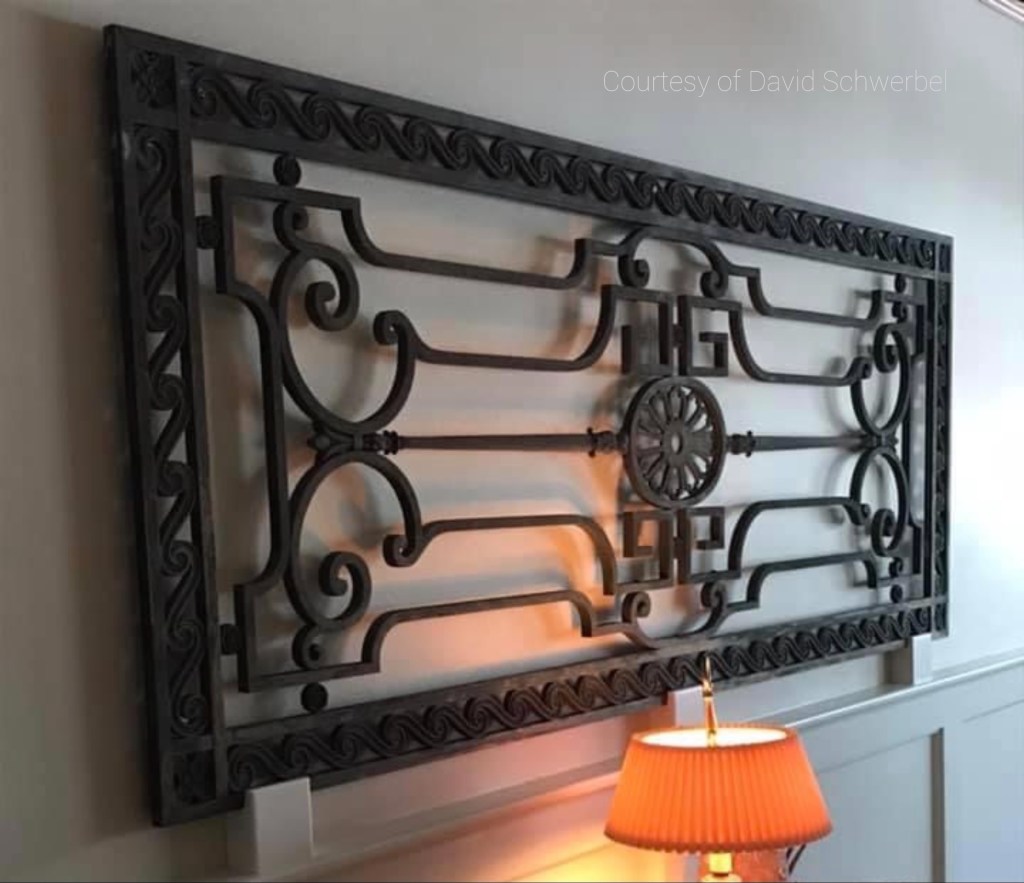
The entrance to the Pinery Room meeting space, specifically designed to hold the doors, gave the library a beautiful grand entrance once again. Unfortunately, the transom that hangs above the doors is not original and it is a fabricated replicate based on the door design. Today the original hangs in the home of a private citizen, and at the time was not available for public display. The replica is slightly different than the first transom, but one would not know without seeing the original.  Regardless of the differences, the current transom beautifully helps to complete the imagery of literally walking through the doors of another time. You can almost smell the books and hear the creaky floors.

The Original Carnegie Library Transom, Photo courtesy of David Schwerbel

The Stevens Point Carnegie Library is a more than a memory from the past, it was more than a building to many, it was an ideal, open to all, that brought a community together and gave its citizens a beautiful place to grow and learn. Locals today fondly reminisce about the smell of ancient books, the sound of the creaking wood floors and the dark varnished wood. Many do not remember the Carnegie Library, nor know it even existed at all. With only stories and artifacts to share, it is important to keep the memory alive of this lost nearly forgotten building of historic Stevens Point.

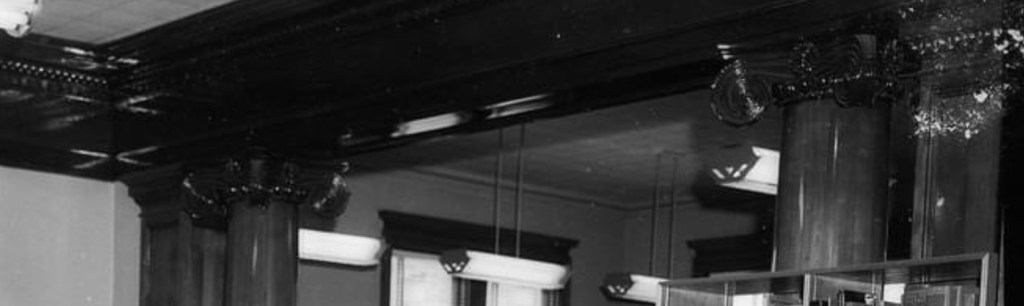
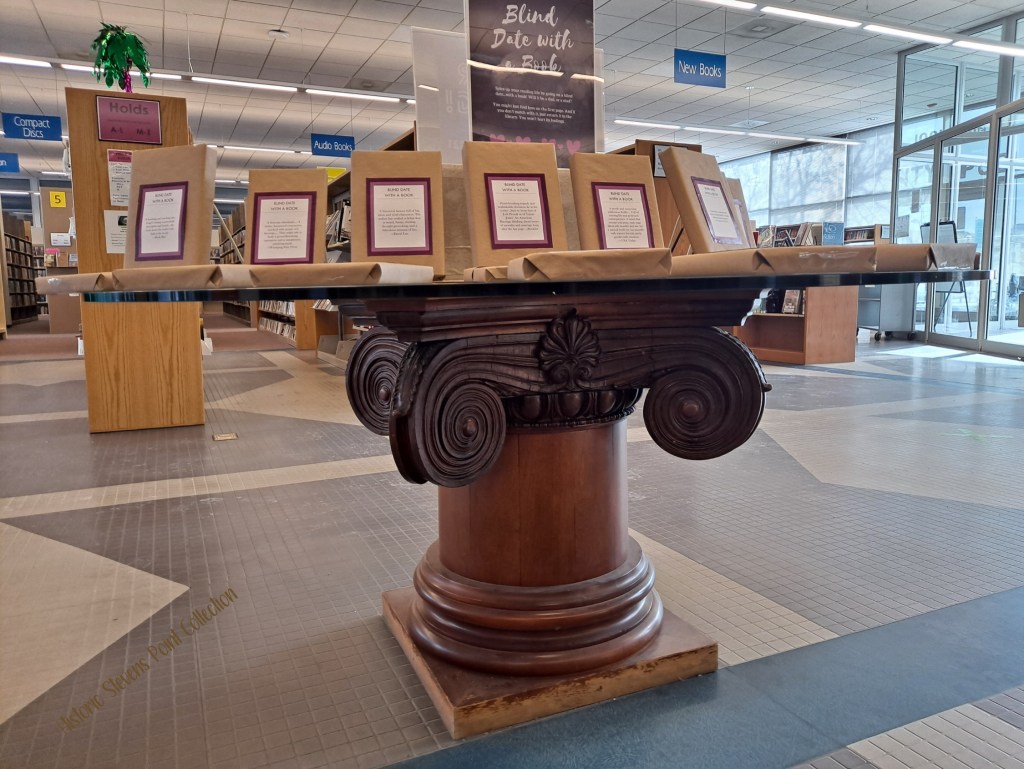
The only other known remnant of the library is the top of one the interior columns which is used as a display table base today at the current Portage County Library building. UWSP /PCHS Archives .
Photo Courtesy of Diane Casselberry of the Portage County Library
UWSP /PCHS Archives
UWSP/PCHS Archives

We would like to extend our gratitude to Diane Casselberry, Linda Kappel, Bruce Barnes, and the late Wendell Nelson for their gift of information and photos while we worked on this piece about Stevens Point’s Lost Carnegie Library. Without their contribution this article could not have been possible.


Read Part 1 here / Read part 2 here Read Part 3 here / Read Part 4 here/ Read Part 5 here

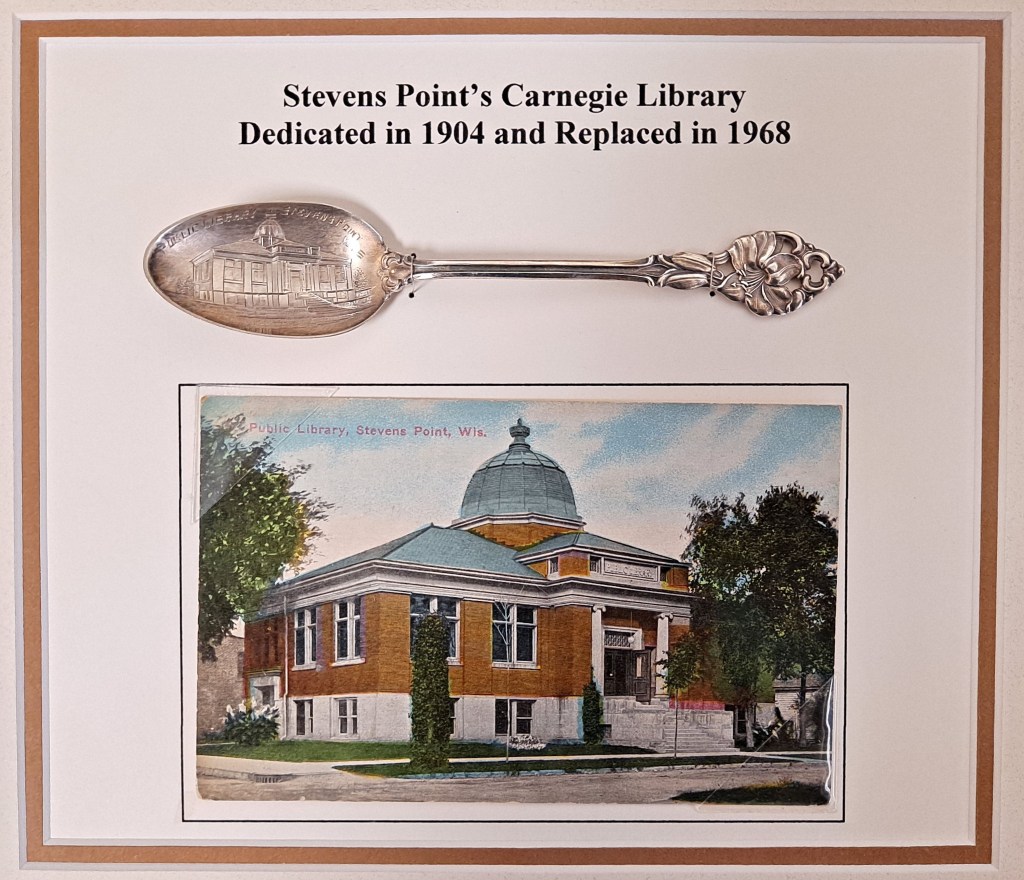
Framed postcard and souvenir spoon displayed in the Portage County Library, photo courtesy of Diane Casselberry
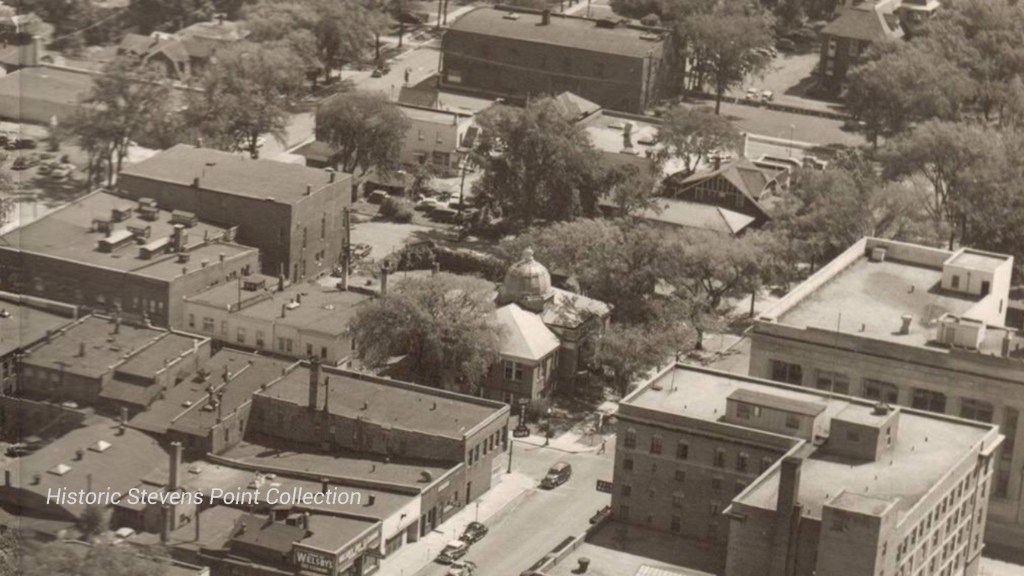
Circa 1953, photo source unknown at time of publishing
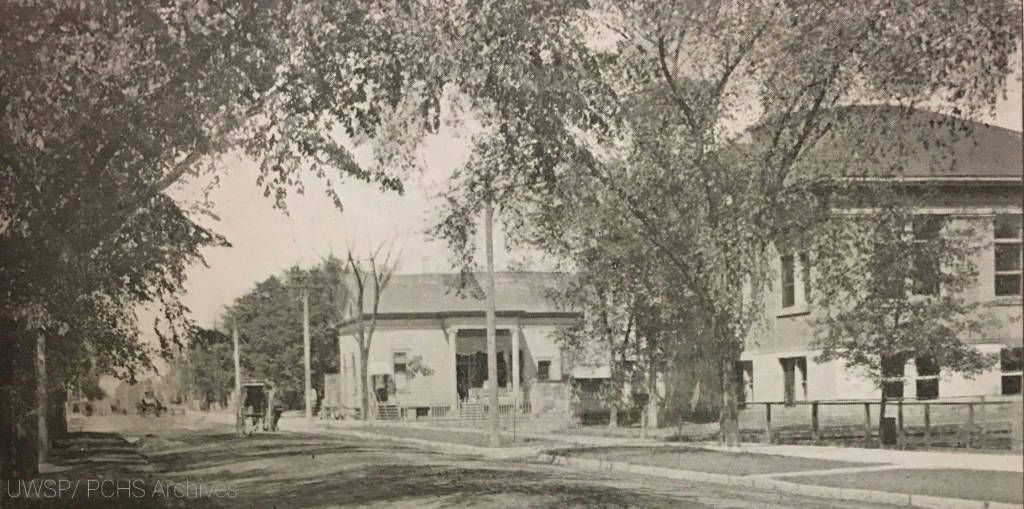
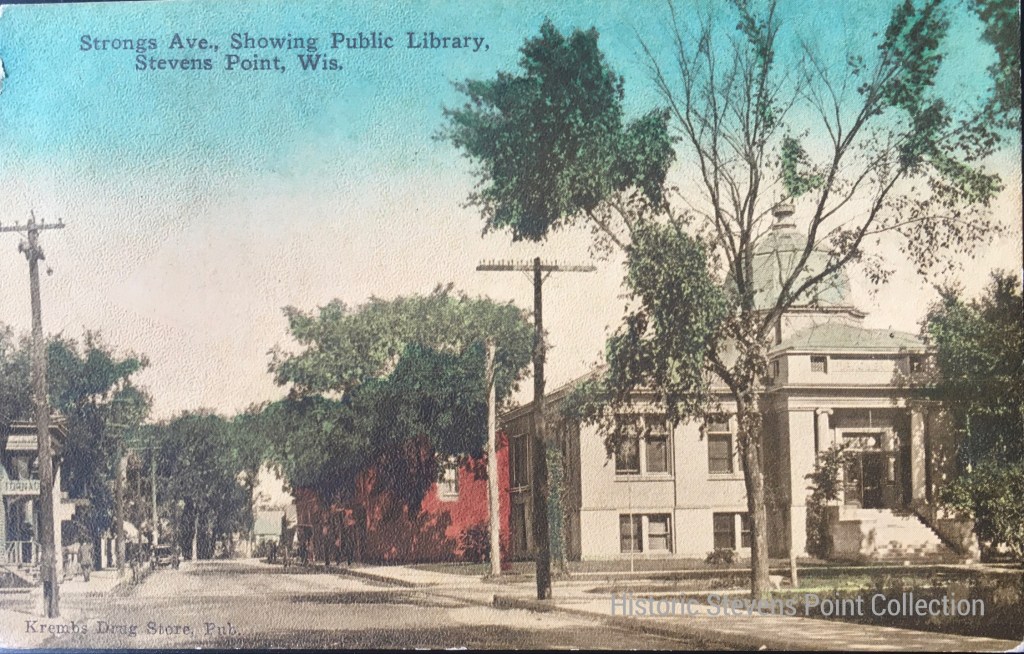
Post card with view from Clark Street looking west towards Strongs Avenue, circa 1908,
UWSP/ PCHS Archives
This early post card image shows a good example of the original doors and transom before the Weeks donation. Pre 1910, UWSP PCHS Archives
Pre 1910, Wisconsin Historical Society
Post card looking north on Strongs Avenue towards Clark Street, circa 1910,
Historic Stevens Point Collection
Circa 1910, original source unknown
Circa 1914, Wisconsin Historical Society
Note the lamp posts and the car parked at the right, Circa 1920, UWSP PCHS Arcives
Circa 1950s, UWSP PCHS Archives
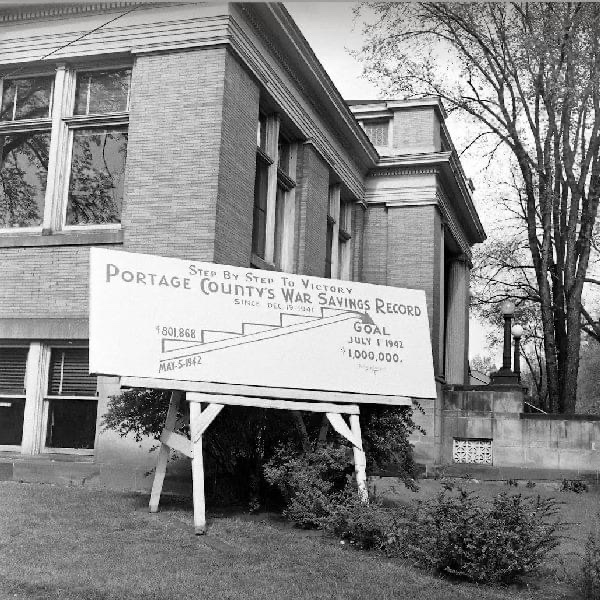
Life Magazine circa 1942
Stevens Point Daily Journal, April 30, 1969

Sources used over the entirety of this piece:
Stevens Point Daily Journal
The Portage County Gazette
Wendell Nelson Papers
Portage County Library Archives
Wisconsin Historical Society Archives
UWSP / PCHS Archives
Sandborn Fire Insurance Maps

Stevens Point’s Lost Carnegie Library: Part 4

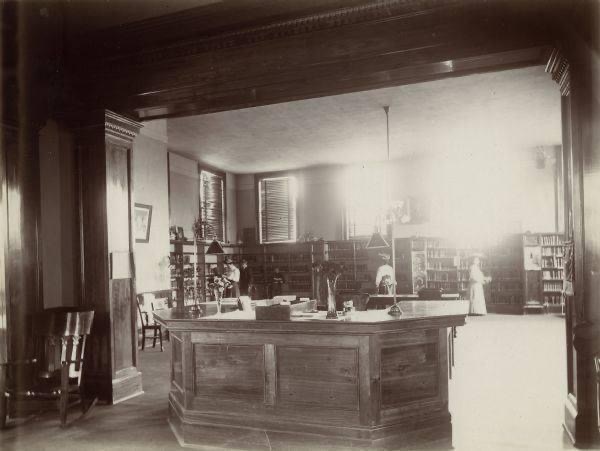
Before the library could officially open to the public, the extensive collection of over 5,000 books and reading materials had to be moved from their old crowded home on the shelves in the rooms above Taylor’s to their new more permanent home on the brand-new freshly varnished shelves just down the road. No records have been found that describe exactly how these books were moved, but one can imagine stacks carried piled to volunteers chins and carts piled high precariously pushed across the rough cobblestone street from one building to the next to finally put in order and shelved by Miss Catlin and Mrs. Dunegan themselves.

Mike Dominowki photo, UWSP / PCHS Archives

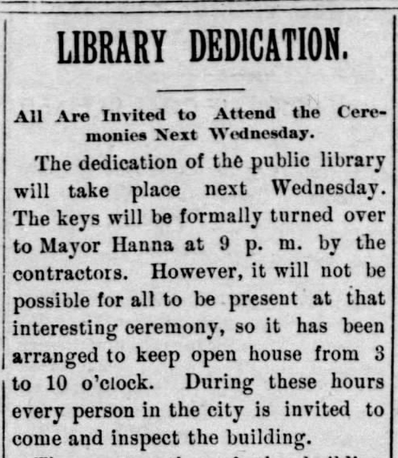
The afternoon of June 1st the doors of Stevens Point’s new Carnegie Library opened to the public for the first time. The words “Open To All,” etched in stone above the entrance greeted the city’s new patrons encouraging all to enter and enjoy. The Union Band was set up in the lobby and an art exhibit of local children’s drawings hung on display in the new children’s reading room.  Decorations were hung sparingly not to overshadow the real stars of the event, the building itself and the books on their new shelves.

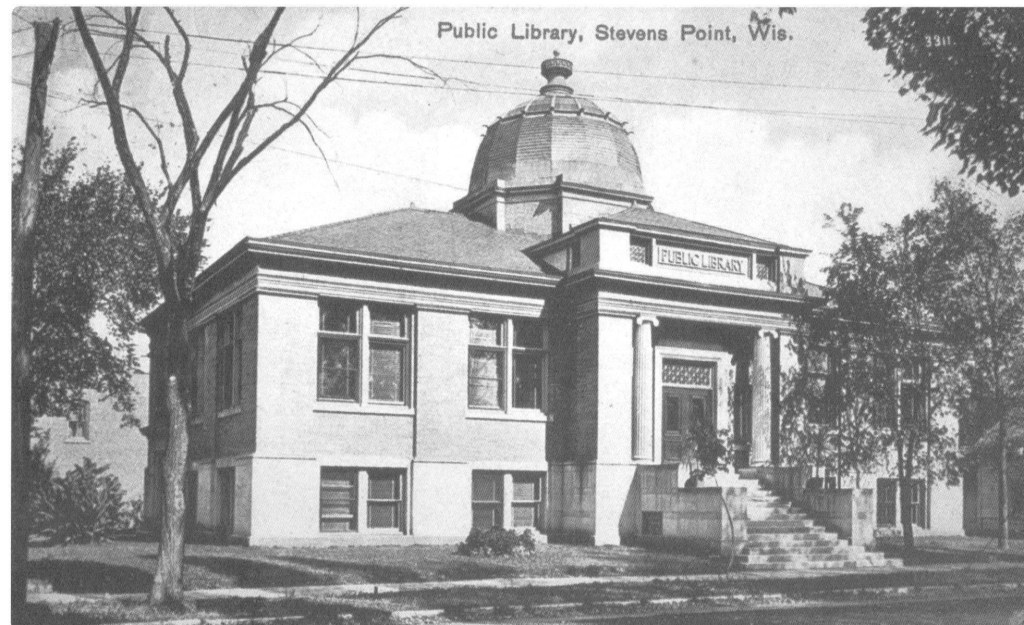
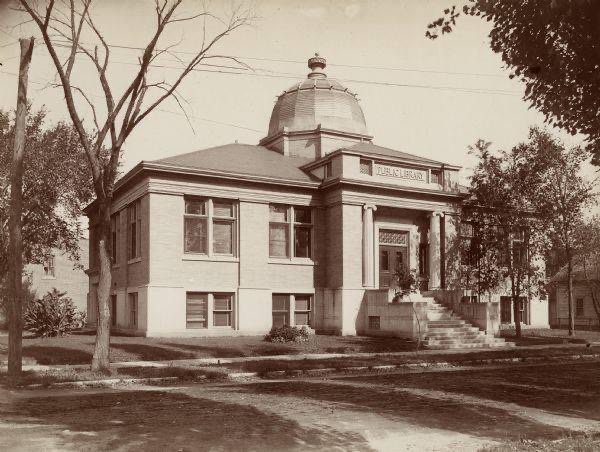
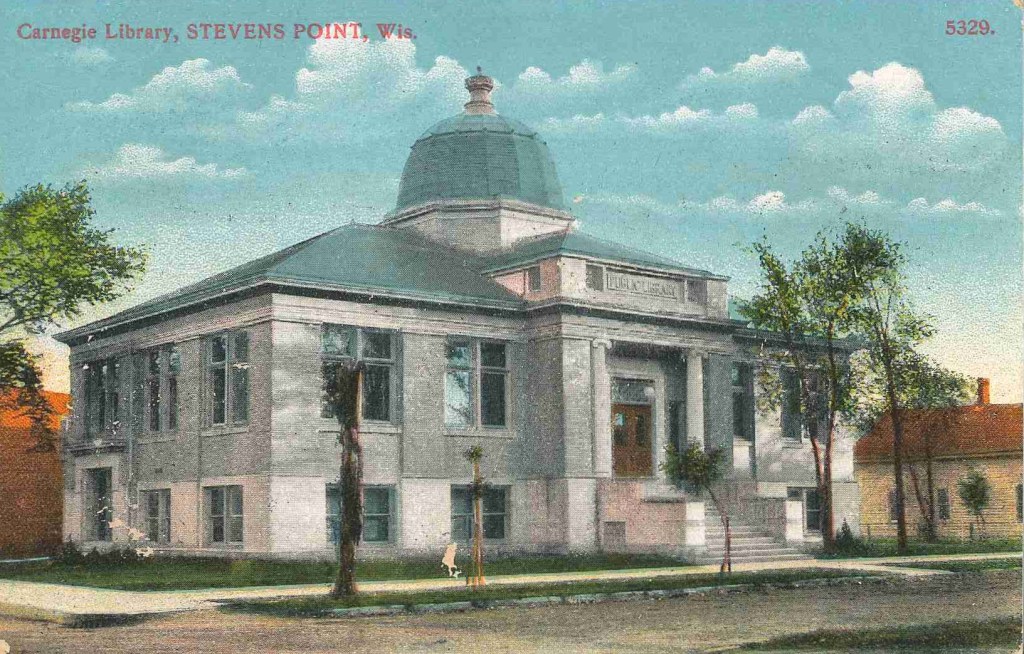
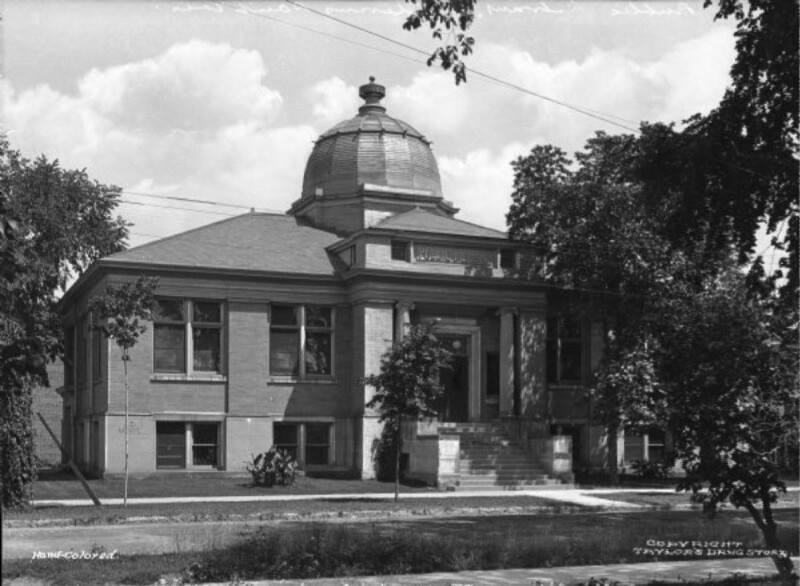
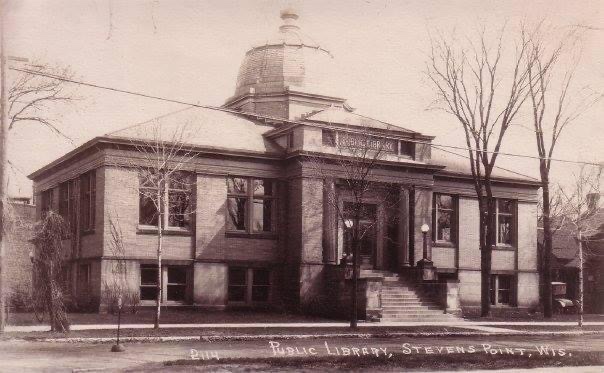
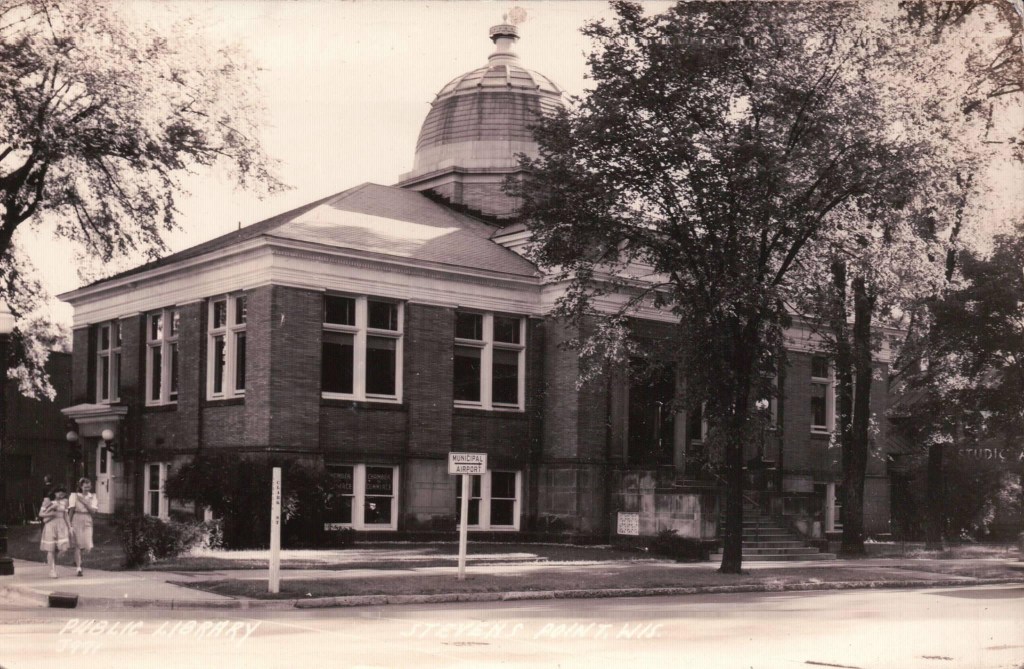
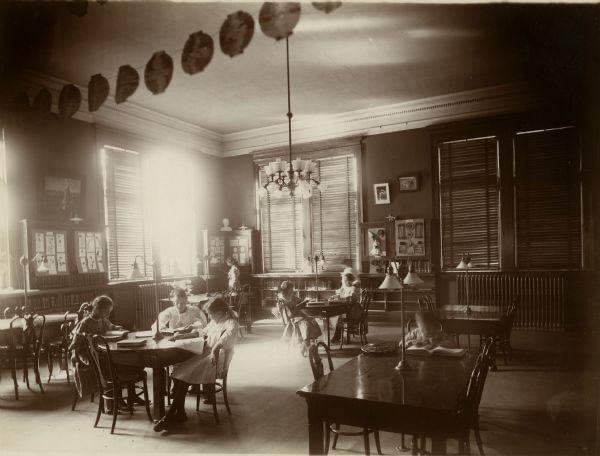
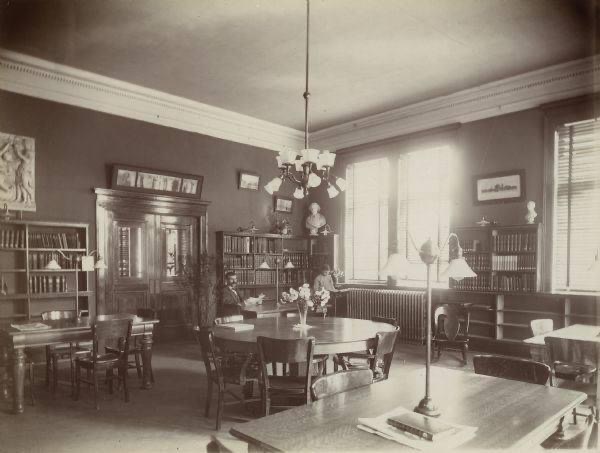
At completion the new library was just as architect drawings showed. The handsome Neo-Classical Revival style building constructed from gray stone and brick was built with a “high basement” to match the height atheistic of the neighboring two-story buildings. The ample stone stairs led to the “broad and inviting” entrance flanked with enormous ionic Roman pillars. Heavy wood doors opened to a wide vestibule with the “librarian’s desk being at the north end of this space.” To the left was a spacious reading room filled with tables and chairs, which housed reference books and the directors’ room. Located in the right wing was the children’s room as well as space for the librarian’s office. The heavily varnished interior woodwork, made from red birch, gave off a warm inviting glow.

A rotunda and dome graced the center of the ceiling and roof line of the building with a skylight made from green art glass specially shipped in by train. It must have been a lovely sight to see the light shine through leaving patterns on the polished wood floors. The original plan called for a narrow gallery around the rotunda, “which is approached by a stairway from the vestibule. The walls of this gallery will be arranged with the idea of using the space for hanging pictures,” making it an engaging focal point when looking to the ceiling.

One of the only known photos of the interior glass of the rotunda. Stevens Point Journal Photo circa 1960

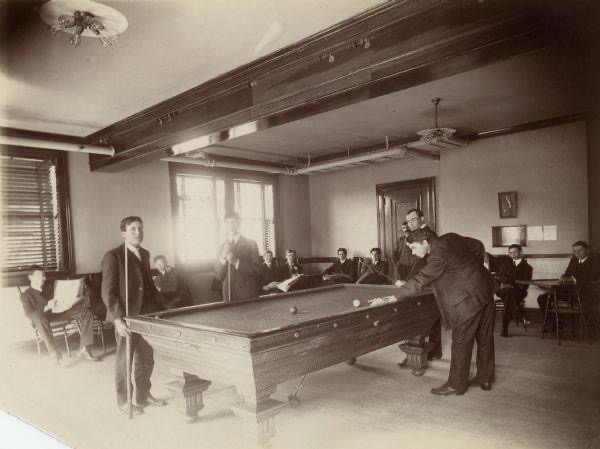
The lower level contained “a lecture hall, a club room for women and a newspaper reading room for men,” as well as a kitchen, storeroom, boiler and fuel rooms, and a librarian’s work room. At some point a carom or French billiards table was moved into the men’s area where boys and men alike gathered to play. Various meetings were held by the ladies in their specified area as well. The Women’s League was very involved in the fundraising for the library and held a permanent contract for their space. Separating the main lower wings of the building was a large open corridor with all three areas able to connect by opening the sliding doors create one large room. The large room was intended to be used for events and lectures for community members.

Gifts from community members were given to the new building as well such as a large potted palm plant and a life-size bust of Shakespeare donated by the graduating class of 1904. But one of the greatest and most beautiful gifts to the library was the donation of a pair of heavy decorative brass and iron doors, a matching iron transom for above the doors as well as a pair of tall ornate brass lamp posts in 1918. Purchased with money left by Andrew Weeks, the doors gave the library quite the grand entrance. Weeks, who had sat on the library board and building committee during the years when the library was being planned. He had also helped raise money for the library fund early on by selling logging land in the Northwoods and then donating it to the cause while the city was preparing to ask Carnegie for the initial donation.

Stevens Point’s Carnegie Library Circa 1914, Wisconsin Historical Society

Coming from a successful lumber and logging family, Weeks died with a significant fortune and left for his time and left money specifically for the Stevens Point Carnegie Library. After his death, his sister ensured that the community received the designated $5000 donation in her brother’s name and helped choose the doors, transom, and lamps. The Weeks family obviously thought it was important that the Stevens Point Public Carnegie Library have a grand entrance.

Read Part 1 here / Read part 2 here Read Part 3 here / Read Part 4 here/ Read Part 5 here

Stevens Point’s Lost Carnegie Library: Part 3

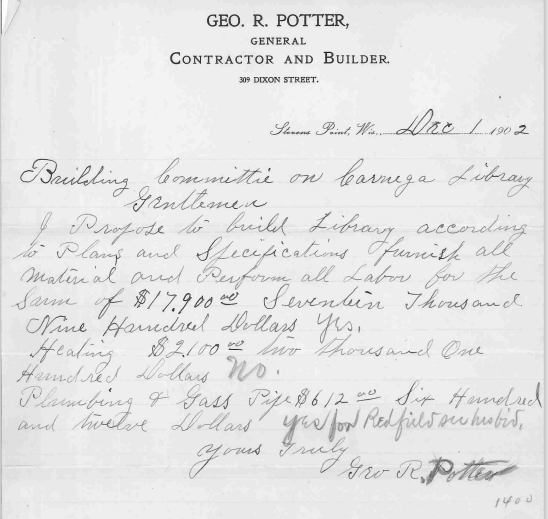
With some dispute, land was eventually obtained at the southwest corner of Strongs Avenue and Clark Street. Soon after Architect Henry A. Foeller, of Green Bay was hired and drawings were made. Bid requests for construction of the library began in October. By December of 1901, George Potter’s $17,900 bid, not including plumbing, heating, nor finishing touches, officially had been accepted.

Courtesy of the Portage County Public Library

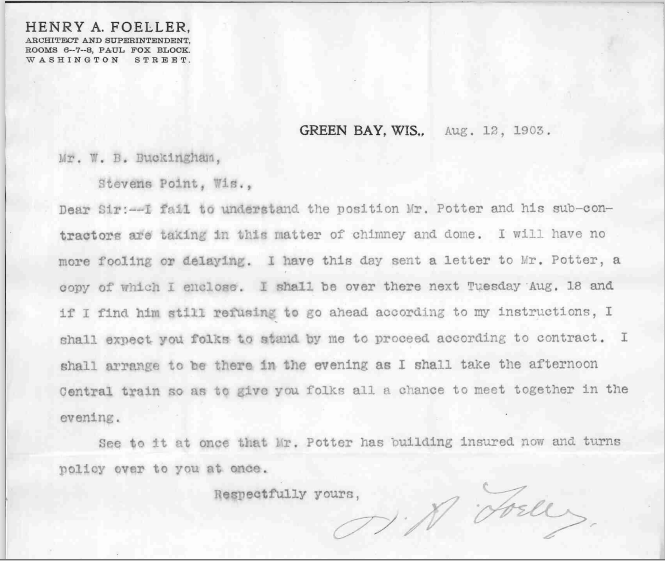
Whereas things seemed to be running smoothly from afar, communications from Foeller show that there were issues between his design and what the contractor produced, as well as other issues with the pace of Potter’s work. There were several setbacks during construction that irritated Foeller enough that he wrote a few strong worded letters regarding the contractor’s work. In a letter dated January 11, 1904 Foeller tells Potter that he “find[s] it useless to urge you on since you seem to take your own time regardless of all notices.”

Aug 12, 1903, “I will have no more fooling or delaying.” Architect Henry Foeller in regards to George Potter. Courtesy of the Portage County Public Library

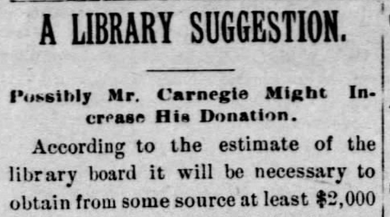
It also seems that it was realized early on that the city would be short funds to reach completion, but work continued to move forward until the money was finally needed. Documents show that after balancing the budget for the building, including monies set aside for plumbing, heating, and the interior, that the city would need $1,858 more or the contractor would lose money. When the time came near completion, there was much discussion as to where to obtain the money.

Stevens Point Daily Journal, Dec 26, 1902

Eventually, Common Council and the Library Board chose to ask Carnegie for more money:

“And while the library spirit is excellent in Stevens Point, and our library circulation is larger than in any other city in Wisconsin of the population of Stevens Point, yet the people are poor, and the additional money, small as it may seem, is hard to get, almost impossible at this time.”

-The Library Board and Stevens Point Common Council to Andrew Carnegie, March 1904

Fundraising continued in the form of a Board of Education vs City Council baseball game to pay for the cement walks and landscaping on the new grounds. Carnegie thankfully agreed to donate the additional funds, and completion pressed on. Opening day plans moved forward.                         

Stevens Point Daily Journal, April 18, 1904

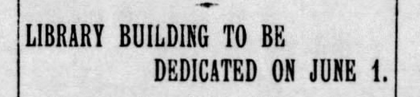
Even with setbacks, two years to the month after Dr. Southwick received the letter from Carnegie’s secretary, the Library Board declared the building finished enough for them to move in and hold meetings. Over the months of April and May they raised the librarian’s monthly salary from $25 to $45, hired an additional assistant librarian, hired a janitor with a $25 monthly wage, and set a reception and dedication date for June 1, 1904. In May, Henry Foeller made a last visit to inspect the building, and as architect he finalized the project, only commenting about the paint job on the outside metal pieces.

And once again, the books were moved.

Stevens Point Daily Journal, May 27, 1904

Read Part 1 here / Read part 2 here Read Part 3 here / Read Part 4 here/ Read Part 5 here

Stevens Point’s Lost Carnegie Library: Part 2

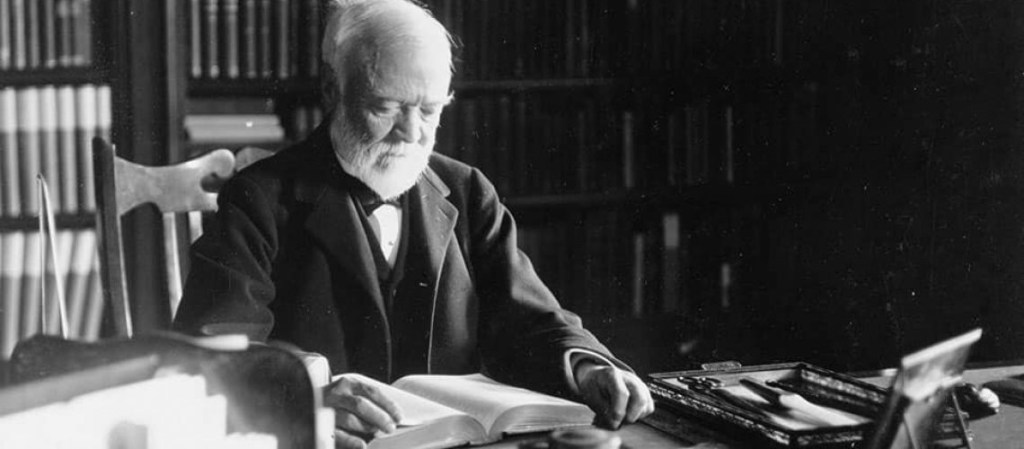
Libraries were not typically free to use anywhere in the United States, let alone the world, during the 19th and early 20th century. Many, such as the Stevens Point’s library, had yearly or monthly fees, fees which some just could not afford. Philanthropist and steel mogul, Andrew Carnegie, believed in free self-education to a high enough degree that he made it a point to create a foundation. Starting in 1881, thousands of Carnegie Libraries were built across the United States. A community just need write and request the donation, but it wasn’t as easy as it sounded. The people would have to come up with their own funding as well. Carnegie required that each city who received library funding guarantee an annual contribution of support consisting of 10% of the original donation before they would be considered.

By January 1902 a few Stevens Point community members had written to Carnegie in hopes of being gifted the funds for a new library building. One of those people was the city physician, Dr. Frank Southwick. Civic minded Southwick had come to Stevens Point from Maine in 1889 and was best known for helping to eradicate diphtheria among the city’s children through immunization. He had managed to gain the attention of Carnegie when others had not, and he had managed to receive a reply stating that consideration would be given to the matter.

Stevens Point Daily Journal April 4, 1902

Shortly after it was announced by local media that Mr. Carnegie wanted to know “how much the city will guarantee,” in support of the library. Specifically, he wanted to know the amount of yearly taxes paid that went currently in support of the library and how much will be guaranteed annually if the building is obtained. At the time, the city had $925 in the annual library tax fund and would need to raise $575 more yearly to support a request of $15,000 from Carnegie, an amount previously suggested.

Courtesy of the Portage County Library

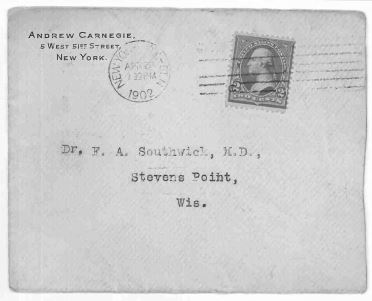
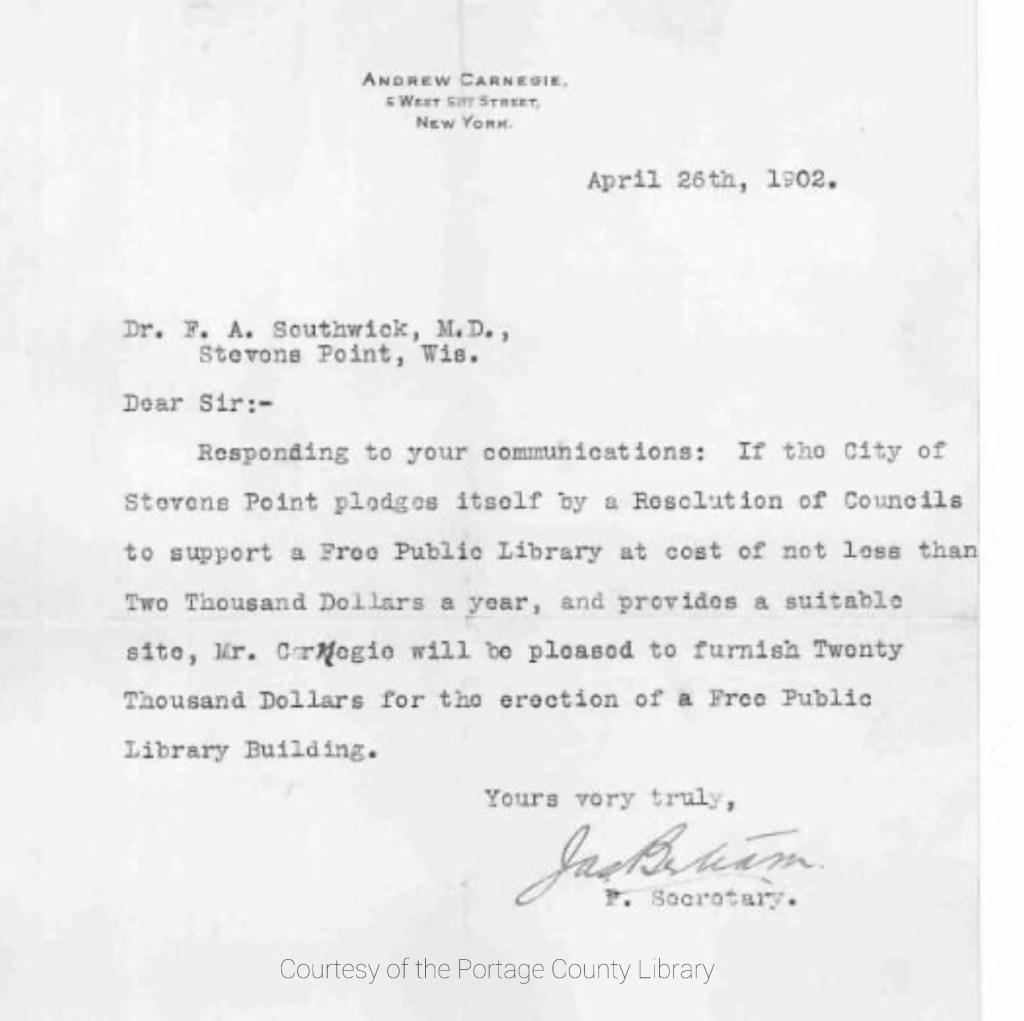
With a few local donations, some from members of the building committee, the Library Board and Common Council decided to ask for larger sum. At the end of April 1902, Dr. Southwick received a letter written by Andrew Carnegie’s secretary letting him know that Mr. Carnegie would be donating $20,000, approximately $613,000 today, towards the completion of a free public library building in Stevens Point.

Read Part 1 here / Read part 2 here Read Part 3 here / Read Part 4 here/ Read Part 5 here

This article was published in the Stevens Point City Times / Portage County Gazette February 20, 2021